Mokauiti - Aria
Catchment monitoring by King Country River Care, commenced in 2021.
Across the entire Mokau River catchment the monitoring programme covers up to 16 monitoring sites across 6 sub-catchments sampled on a quarterly basis. Waikato Regional Council (WRC) has 5 monitoring sites in 4 of these 6 sub-catchments, which are monitored monthly.
A water quality baseline was calculated from the time the catchment group was formed using five years (Jan 2015 – Dec 2019) of monthly monitoring data, collected at the WRC sites.
The location of the monitoring sites for each sub-catchment are shown on the map to the right.
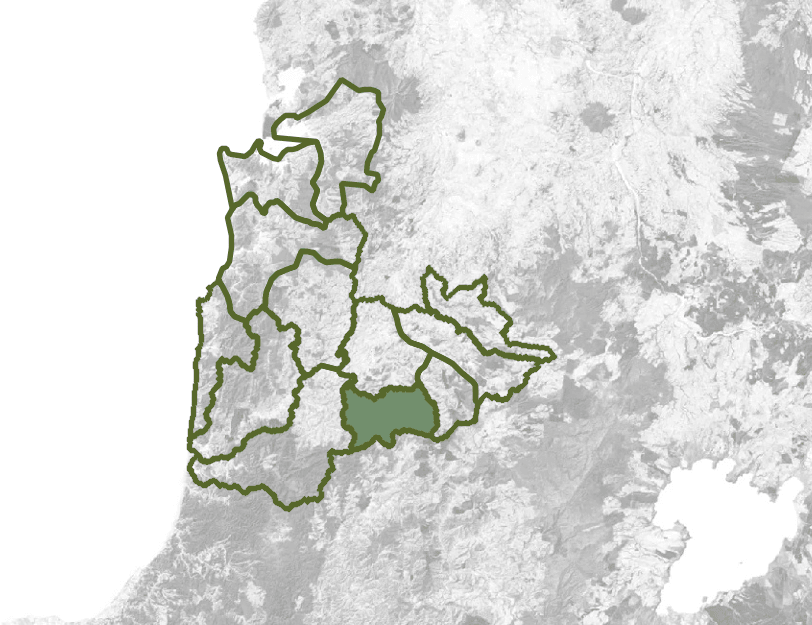
Sub Catchment Monitoring Sites
Key Resources Being Lost from the Land
Monitoring across five sites in 2025 shows that the key resources lost from the Mokauiti-Aria sub-catchment were E. coli and Sediment (reflected by low water clarity).
Loss of Sediment represents a loss of soil and nutrients.
Elevated E. coli represents a loss of organic matter and nutrients as it is largely associated with animal manure in rural catchments.
Catchment Hotspots
E. coli: Measurements were generally lower than 2024, although elevated in Huioteko Stream, which did not meet national health guidelines for swimming. Concentrations were also slightly elevated in Ramaroa Stream.
Sediment: Suspended sediment was highest in Mokauiti Stream, which did not meet the national bottom line, and was lowest in Ramaroa Stream.
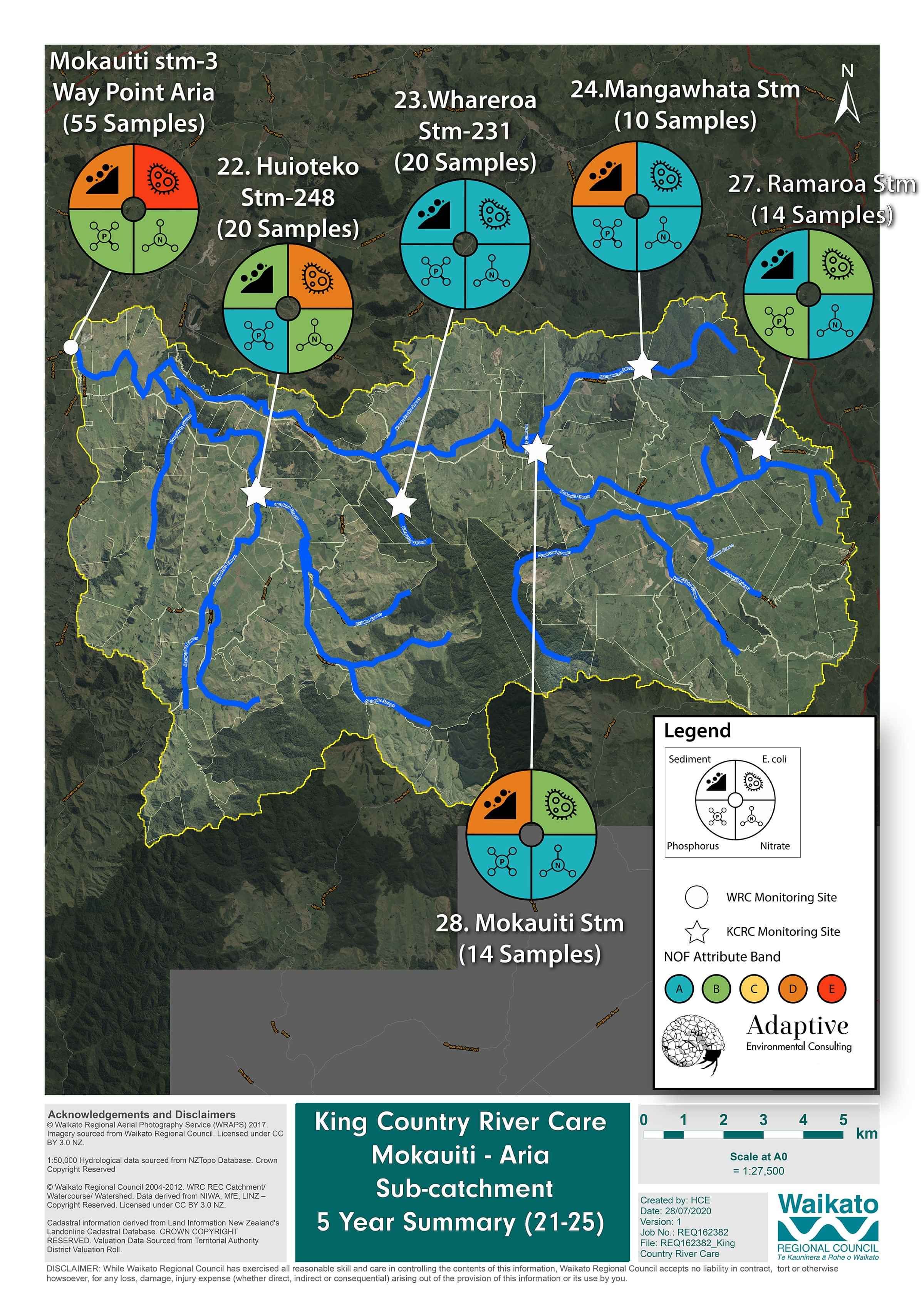
The water quality dials summarise the results collected from the sites in the Mokauiti-Aria sub-catchment alongside the Mokau River water quality baseline. The dial on the left shows the baseline for Mokau River, covering 5 years of regional council monitoring at the five WRC monitoring sites (Awakau Road, Mokauiti Stream at 3-way Point Aria, Mangaotaki River-SH3 bridge, Totoro Road and Mangaokewa Road off SH30). The dial on the right combines all data collected at the five sites in the Mokauiti-Aria sub-catchment in 2025, 27 samples in total. Arrows indicate either an increase or decrease in values compared to the sub-catchment baseline. An increase in water clarity is positive for river health while an increase in all other indicators may impair river health.
In 2025, indicators for nutrients and E. coli met national water quality limits, while water clarity/suspended sediment and did not. Compared to the baseline – Water clarity was higher while E. coli & dissolved reactive phosphorus were lower. Nitrogen remained unchanged.
Full Report Available to Download
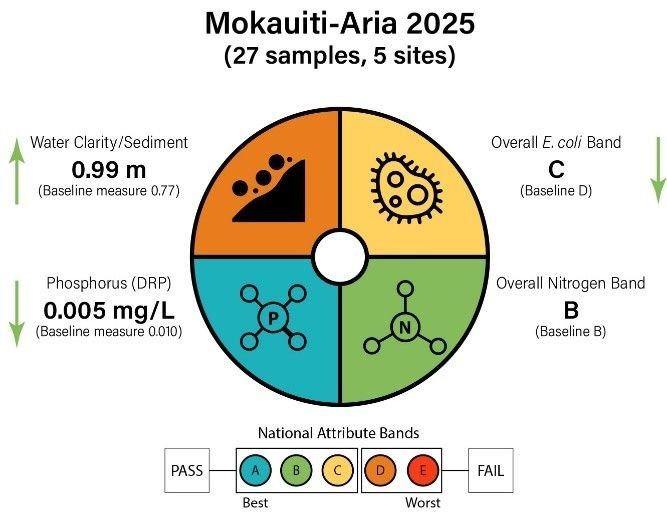
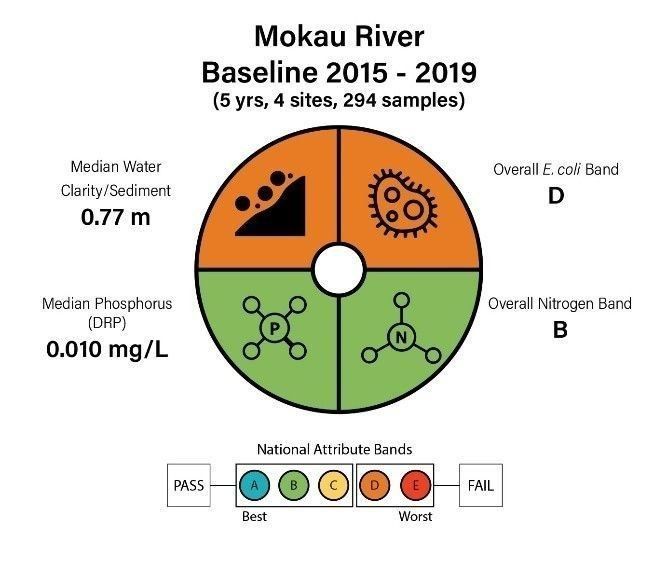
Water quality dials for the Mokauiti - Aria catchment.
The bottom dial shows the sub-catchment baseline (2015-2019)
The top dial combines results collected in the 2025 monitoring period.
2025 Quarterly Summaries
February 2025
Water quality was Good in Mokauiti stream (Site 28), Fair in Huioteko stream (Site 22) and Whareroa stream (Site 23) and Poor in Ramaroa stream (Site 27).
E. coli concentrations were very low in Mokauiti stream (17 cells per 100 mL) and slightly elevated in Whareroa stream (410 cells per 100 mL) but fell within recommended health guidelines. E. coli was very high in Ramaroa stream (1,300 cells per 100 mL) and elevated in Huioteko stream (780 cells per 100 mL), both sites exceeded recommended health guidelines for swimming (540 cells per 100 mL).
Nitrogen:
Nitrate concentrations were low in all sites (≤ 0.16 mg/L), falling well below ecological toxicity levels (2.4 mg/L). Ramaroa stream and Mokauiti stream had the lowest concentrations (0.01 mg/L) and Whareroa stream had the highest concentrations (0.16 mg/L). Ammonia concentrations were low in Ramaroa stream and Mokauiti stream (≤ 0.02 mg/L) and were slightly elevated in Huioteke stream (0.20 mg/L) and Whareroa stream (0.12 mg/L).
Dissolved inorganic nitrogen (DIN) was also low across all sites (≤ 0.29 mg/L), falling well below the ecological impact threshold (0.5 mg/L).Phosphorus:
Dissolved reactive phosphorus (DRP) concentrations were low in Whareroa stream and Mokauiti stream (≤ 0.004 mg/L). Huioteko stream had slightly elevated DRP concentrations (0.012 mg/L) and Ramaroa stream had very high concentrations (0.024 mg/L).Suspended sediment/Water Clarity:
Water clarity was excellent in Ramaroa stream (1.42 m) but was poor in the other three sites (≤ 1.02 m), relative to the national bottom line (1.34 m for Mokauiti stream and 0.61 m for all other sites). Huioteko stream had the lowest water clarity (0.12 m).
The results in the table below have been graded according to the National Policy Statement for Freshwater Management (NPS-FM, 2020).
Collection date: 18th February 2025

Mokau River - Summary of water quality collected from 15 sites across the Mokau River catchment on 18th February 2025
Most sites had low nutrient levels, but elevated E. coli and poor water clarity were common, with a few locations exceeding human health and ecological health thresholds.
E. coli: 60% of sites had elevated concentrations (between 890 and 3,100 cells per 100 mL), 20% (3 sites) had slightly elevated concentrations (between 300 and 500), and 20% had low concentrations (≤ 170).
Nitrogen:
Nitrate: 100% of sites had low concentrations (range = 0.001 to 0.56 mg/L).
Ammonia: 100% of sites were low to moderate (range = <0.005 to 0.200 mg/L).
Dissolved Inorganic Nitrogen (DIN): 93% of sites had low concentrations (≤ 0.50 mg/L), and 7% (1 site) was slightly elevated (0.58 mg/L), exceeding the ecological impact threshold of 0.5 mg/L.Phosphorus:
Dissolved Reactive Phosphorus (DRP): 80% of sites had low concentrations (between <0.002 and 0.009 mg/L), 13% (2 sites) were slightly elevated (0.011 – 0.012 mg/L), and 7% (1 site) returned a very high concentration (0.024 mg/L).Suspended Sediment / Water Clarity: 47% of sites had good water clarity (A or B band), 7% (1 site) had fair water clarity (C band), and the remaining 47% had poor water clarity (D band). Bands for each site relate to the National Bottom Line (NBL) for water clarity and depend on landscape characteristics including geology, climate, and elevation. The NBL for Mokau River monitoring sites is either 1.34 m or 0.61 m, depending on local landscape characteristics.
2025 Quarterly Summaries
May 2025
Water quality was Excellent in Whareroa stream (Site 23), Good in Huioteko stream (Site 22) and Ramaroa stream (Site 27), and Fair in Mokauiti stream (Site 28).
E. coli concentrations were low in Ramaroa stream, Whareroa stream and Mokauiti stream (≤ 210 cells per 100 mL) and slightly elevated in Huioteko stream (440 cells per 100 mL). All sites fell within health guidelines for swimming (540 cells per 100 mL), and Ramaroa stream met guidelines for livestock drinking water (< 100 cells per 100 mL).
Nitrogen:
Nitrate concentrations were low in all sites (≤ 0.28 mg/L), falling well below ecological toxicity levels (2.4 mg/L). Ramaroa stream had the lowest concentration (0.06 mg/L) and Huioteko stream had the highest (0.28 mg/L).
Ammonia concentrations were low in all sites (≤ 0.08 mg/L).
Dissolved inorganic nitrogen (DIN) was low across all sites (≤ 0.28 mg/L), falling well below the ecological impact threshold (0.5 mg/L).Phosphorus:
Dissolved reactive phosphorus (DRP) concentrations were very low in three sites (≤ 0.005 mg/L) and slightly elevated in Ramaroa stream (0.013 mg/L).Suspended sediment/Water Clarity:
Water clarity was Excellent in three sites (0.98 m - 1.33 m) but was Poor in Mokauiti stream (≤ 1.33 m), relative to the national bottom line (1.34 m for Mokauiti stream and 0.61 m for all other sites).
The results in the table below have been graded according to the National Policy Statement for Freshwater Management (NPS-FM, 2020).
Collection Date: 15th May 2025

Mokau River – Summary of water quality collected from 15 sites across the Mokau River catchment on 15th May 2025
Water quality was Fair across the Mokau River Catchment. While most sites had low to moderate levels of E. coli, nitrogen, and phosphorus, and water clarity was good at over half the locations, a few sites exceeded ecological thresholds for nutrients and water clarity.
E. coli (Microbial Contamination):
Most sites (60%) had low concentrations (≤ 230 cells per 100 mL) low risk for swimming.
Two sites (13%) had very low concentrations (< 100), considered safe for livestock drinking water[1].
A third of sites (33%) had slightly elevated concentrations (370 - 490 cells per 100 mL).
One site (Puputaha stream) had high levels (690 cells per 100 mL) which could pose a health risk, especially when swimming.Nitrogen
Nitrate:
All 15 sites had low to moderate concentrations (0.06 - 0.80 mg/L), falling well below ecological toxicity thresholds (2.4 mg/L) for native fish and invertebrates.
However, 4 sites exceeded ecological impact thresholds (0.5 mg/L), which can affect stream health.
Ammonia:
All sites had very low concentrations (<0.005 - 0.08 mg/L), little concern for aquatic life.
Dissolved Inorganic Nitrogen (DIN):
Most sites (73%) had low concentrations (≤ 0.46 mg/L).
Four sites (27%) were slightly elevated (0.63 - 0.80 mg/L), exceeding the ecological impact threshold of (0.5 mg/L).Phosphorus
Dissolved Reactive Phosphorus (DRP):
Two-thirds of sites (67%) had low levels (<0.002 - 0.009 mg/L).
Five sites (33%) were slightly elevated (0.011 – 0.014 mg/L) which can contribute to problematic plant and algae growth if levels stay high.Suspended Sediment / Water Clarity:
Over half of sites (53%) had Good water clarity (A or B band).
Two sites (13%) had Fair water clarity (C band).
A third of sites (33%) had Poor water clarity (D band).
Water clarity bands for each site are based on the National Bottom Line (NBL), which varies depending on local landscape characteristics (e.g. geology, climate, and elevation). For Mokau River sites, the NBL is either 1.34 m or 0.61 m, depending on location.
[1] Drinking water for livestock should contain < 100 cfu/100 mL (median value) of E. coli. Livestock Drinking Water Guidelines (2023), Australian & New Zealand Guidelines for Fresh & Marine Water Quality.
2025 Quarterly Summaries
August 2025
Water quality was Excellent in Whareroa stream (Site 23) and Ramaroa stream (Site 27), Good in Huioteko stream (Site 22), and Fair in Mokauiti stream (Site 28).
E. coli concentrations were low across all sites (≤ 240 cells per 100 mL). All sites fell within health guidelines for swimming (540 cells per 100 mL), and Ramaroa stream and Whareroa stream met guidelines for livestock drinking water (< 100 cells per 100 mL).
Nitrogen:
Nitrate concentrations were low three sites (≤ 0.50 mg/L) and slightly elevated in Huioteko stream (0.55 mg/L). All sites fell well below the ecological toxicity threshold (2.4 mg/L).
Ammonia concentrations were low in three sites (≤ 0.03 mg/L) and slightly elevated in Huioteko stream (0.15 mg/L).
Dissolved inorganic nitrogen (DIN) was low across three sites (≤ 0.5 mg/L) but slightly elevated in Huioteko stream (0.7 mg/L), exceeding the ecological impact threshold (0.5 mg/L).Phosphorus:
Dissolved reactive phosphorus (DRP) concentrations were low in all sites (≤ 0.008 mg/L).Suspended sediment/Water Clarity:
Water clarity was Excellent in three sites (1.01 m - 1.45 m) and Poor in Mokauiti stream (0.56 m), relative to the national bottom line (1.34 m for Mokauiti stream and 0.61 m for all other sites).
The results in the table below have been graded according to the National Policy Statement for Freshwater Management (NPS-FM, 2020).
Sample Collection Day: 25th August 2025

Mokau River – Summary of water quality collected from 15 sites across the Mokau River catchment on 25th August 2025
Water quality was Fair across the Mokau River Catchment. While most sites had low to moderate levels of E. coli and phosphorus, 80% of all sites had poor water clarity and exceeded the ecological threshold for dissolved inorganic nitrogen.
E. coli (Microbial Contamination):
Most sites (73%) had low concentrations (≤ 240 cells per 100 mL), a low risk for swimming.
Three sites (20%) had very low concentrations (< 100), considered safe for livestock drinking water[1].
Four sites (27%) had slightly elevated concentrations (280 - 460 cells per 100 mL).Nitrogen
Nitrate:
Three sites (20%) had low concentrations (≤ 0.5 mg/L).
Twelve sites (80%) exceeded ecological impact thresholds (0.5 mg/L), which can affect stream health.
All sites fell well below ecological toxicity thresholds (2.4 mg/L) for native fish and invertebrates.
Ammonia:
Most sites had low concentrations (<0.005 - 0.03 mg/L), of little concern for aquatic life.
One site (Huioteko stream) had slightly elevated concentrations (0.15 mg/L), which can impact sensitive aquatic species.
Dissolved Inorganic Nitrogen (DIN):
Three sites (20%) had low concentrations (≤ 0.50 mg/L).
10 sites (67%) were slightly elevated (0.51 – 1.0 mg/L), exceeding the ecological impact threshold of (0.5 mg/L).
Two sites (13%) had concentrations exceeding 1 mg/L, which is of particular concern for aquatic life.Phosphorus
Dissolved Reactive Phosphorus (DRP):
Most sites (93%) had low levels (<0.002 - 0.009 mg/L).
One site (Waitanguru) was slightly elevated (0.012 mg/L), which can contribute to problematic plant and algae growth if levels stay high.Suspended Sediment / Water Clarity:
Three sites (20%) had Excellent water clarity (A band).
One site (Waitanguru stream) had Fair water clarity (C band).
Nearly three quarters of all sites (73%) had Poor water clarity (D band).
Water clarity bands for each site are based on the National Bottom Line (NBL), which varies depending on local landscape characteristics (e.g. geology, climate, and elevation). For Mokau River sites, the NBL is either 1.34 m or 0.61 m, depending on location.
[1] Drinking water for livestock should contain < 100 cfu/100 mL (median value) of E. coli. Livestock Drinking Water Guidelines (2023), Australian & New Zealand Guidelines for Fresh & Marine Water Quality.
2025 Quarterly Summaries
November 2025
Water quality was Excellent in Whareroa stream (Site 23) and Ramaroa stream (Site 27), and Fair in Huioteko stream (Site 22) and Mokauiti stream (Site 28).
E. coli concentrations were very low in the Whareroa and Ramaroa streams (66 cells per 100 mL), meeting recommended guidelines for swimming (540 cells per 100 mL) and livestock drinking water (< 100 cells per 100 mL). Concentrations was slightly elevated in the Huioteko and Mokauiti streams (350 - 360 cells per 100 mL) but still fell within swimming guidelines.
Nitrogen: Nitrate concentrations were low across all sites (≤ 0.36 mg/L), falling well below the ecological toxicity threshold (2.4 mg/L). Ammonia concentrations were low in three sites (≤ 0.03 mg/L) and slightly elevated in Huioteko stream (0.032 mg/L). Dissolved inorganic nitrogen (DIN) was low across all sites (≤ 0.36 mg/L), falling below the ecological impact threshold (0.5 mg/L).
Phosphorus: Dissolved reactive phosphorus (DRP) concentrations were low in Whareroa stream and Ramaroa stream (≤ 0.010 mg/L), slightly elevated in Mokauiti stream (0.011 mg/L) and elevated in Huioteko stream (0.019 mg/L).
Suspended sediment: Water clarity was Excellent in the Whareroa and Ramaroa streams (0.99 - 1.08 m), Fair in Huioteko stream (0.63 m) and Poor in Mokauiti stream (0.45 m), relative to the national bottom line (1.34 m for Mokauiti stream and 0.61 m for all other sites).
The results in the table below have been graded according to the National Policy Statement for Freshwater Management (NPS-FM, 2020).
Sample Collection Day: 12th November 2025

Mokau River – Summary of water quality collected from 15 sites across the Mokau River catchment on 12th November 2025
Water quality was Fair across the Mokau River Catchment. While most sites had low to moderate levels of nitrogen and phosphorus, 73% of all sites had poor water clarity and 60% had elevated E. coli concentrations. The sites with the best water quality in the Mokau River catchment were Whareroa stream, Ramaroa stream, and Waitanguru stream.
E. coli (Microbial Contamination):
Three sites (20%) had low concentrations (≤ 190 cells per 100 mL), a low risk for swimming.
Two sites had very low concentrations (< 100), considered safe for livestock drinking water[1].
Another three sites (20%) had slightly elevated concentrations (350 - 400 cells per 100 mL)
Just under two thirds of sites (60%) had very high concentrations (610 – 2,200), which exceeded recommended levels for swimming.
Nitrogen
Nitrate:
Two thirds of sites (67%) had low concentrations (≤ 0.48 mg/L) and a third of sites exceeded this ecological impact threshold (> 0.5 mg/L), which may affect stream health.
All sites fell well below ecological toxicity thresholds (2.4 mg/L) for native fish and invertebrates.Ammonia:
Most sites had low concentrations (<0.005 - 0.03 mg/L), of little concern for aquatic life.
Two sites had slightly elevated concentrations (> 0.03 mg/L), which can impact sensitive aquatic species.Dissolved Inorganic Nitrogen (DIN):
Two thirds of sites (67%) had low concentrations (≤ 0.50 mg/L).
The other third had slightly elevated concentrations (0.53 – 0.77 mg/L), exceeding the ecological impact threshold of 0.5 mg/L.
Phosphorus
Dissolved Reactive Phosphorus (DRP):
Two thirds of sites (67%) had low concentrations (0.003 - 0.01 mg/L).
The other third of sites had slightly elevated concentrations (0.011 – 0.013 mg/L), which can contribute to problematic plant and algae growth if levels stay high.
Suspended Sediment / Water Clarity:
Three sites (20%) had Excellent water clarity (A band).
One site had Fair water clarity (C band).
Nearly three quarters of all sites (73%) had Poor water clarity (D band).
Water clarity bands for each site are based on the National Bottom Line (NBL), which varies depending on local landscape characteristics (e.g. geology, climate, and elevation). For Mokau River sites, the NBL is either 1.34 m or 0.61 m, depending on location.
[1] Drinking water for livestock should contain < 100 cfu/100 mL (median value) of E. coli. Livestock Drinking Water Guidelines (2023), Australian & New Zealand Guidelines for Fresh & Marine Water Quality.
Mokauiti - Aria
Data & Downloads
->
Aquatic Biodiversity Summary
Biodiversity monitoring includes eDNA, collected by KCRC, and traditional biodiversity monitoring techniques (netting of freshwater invertebrates and netting and electrofishing of freshwater fish), by Waikato Regional Council (WRC). eDNA sampling has been done by KCRC, in autumn and winter in 2021, 2022 and 2023. WRC monitors most sites every 1 to 2 years, between November and March. If more than one results is available for any single monitoring location the results for that site are averaged across years.
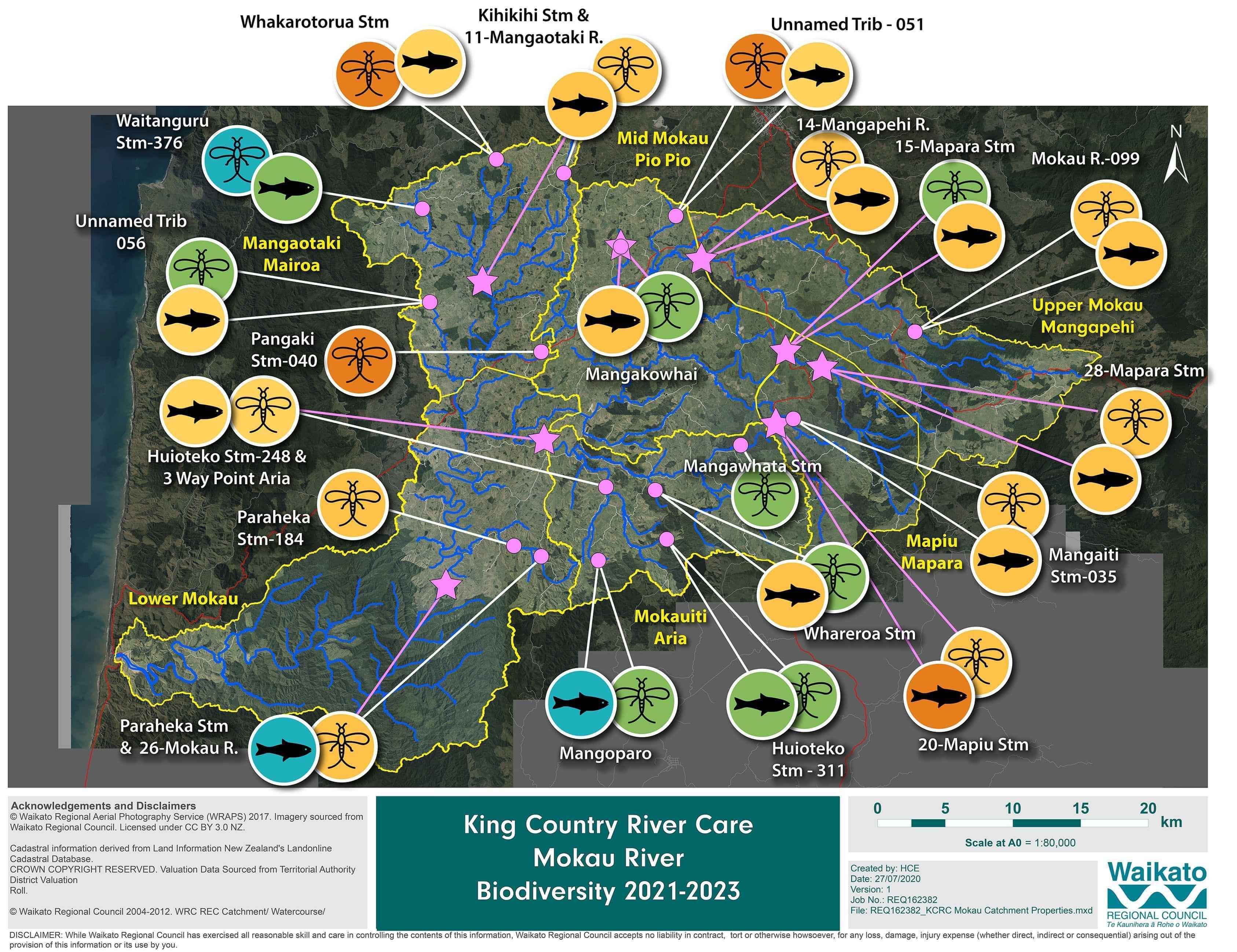
Mōkau River has signs of ecological stress.
Freshwater invertebrate MCI scores indicate ecological stress at some sites in all sub-catchments expect for Mokauiti-Aria, where nearly all sites had good MCI scores and two out of three sites had good fish scores. Mangaotaki-Mairoa also had two sites with good invertebrate scores.
The number of insect species detected from eDNA (an indicator for ecological health) were low to moderate, ranging between 20 to 40 species across the 7 sub-catchments. Mapiu stream, Mapara stream, Mangaotaki and Mokauiti streams had the highest number of insect species, while Mangaokowhai stream and the Upper Mōkau had the lowest number of insect species detected.
Native freshwater mussels, a rare invertebrate species and filter feeder, were detected in the sub-catchments of upper Mōkau, Mokauiti-Aria and the lower Mōkau.
The Mōkau river has a diverse fish community in the lower reaches (14 species), however, fish diversity is very low in the mid and upper reaches, consisting mainly of eels (longfin and shortfin) and brown trout.
Only one whitebait species was detected, Īnanga, in the lower reaches only.
Threatened fish species detected in the catchment include, lamprey, Īnanga, redfin bully, longfin eel and torrentfish.
Four species of introduced fish detected, mosquito fish, goldfish, brown trout and rainbow trout.
Barriers to fish migration in the Mōkau river, including manmade structures like dams and perched culverts and natural features like high waterfalls, will be restricting fish diversity.
The Mōkau River has at least two large manmade barriers to fish migration, the Mokauiti Dam and the Wairere Dam, and at least on large natural barrier, Omaru falls (45m high).
Many of our native species are excellent climbers, elvers can scale waterfalls up to 40 m high and kōaro even higher than this.